Archive for the 'Age 11-12/Grade 6-8/Tween' Category

Game On with Katie Salen at Quest to Learn

Monday, January 4th, 2010

Katie Salen, visionary behind a new school in New York City called Quest to Learn

It seems wherever I travel, educational publishers, learning theorists, and teachers of all kinds bring up the concept of learning through interactive games. It’s an idea that’s been picking up steam over the last few years, and why not? Research from the PEW Internet and American Life Project last year found that 98% kids ages 12 – 17 play video games. Organizations like the MacArthur Foundation have been funding a small number of projects to test out new ideas for using interactive games with learning in mind. A few months ago I came across a great article in the Economist about a new public school opening in New York City that uses gaming principles to teach its students. At the recent Breakthrough Learning in a Digital Age conference held at the Google headquarters, I had the opportunity to speak with Katie Salen, the visionary behind this initiative. You can view a short video of my interview with Katie on the Cooney Center YouTube channel or read the complete interview below. Portions of this interview were edited for clarity:

QUICK QUESTION PICKER:

Tell us about your new school, Quest to Learn.

How did you recruit teachers for your school?

Was it hard to get teachers around the concept of teaching from a game design perspective?

How are the students working with the teachers who apply this teaching model?

How do you divide up the class day?

Is it your intent to open up more Quest to Learn schools?

INTERVIEW:

Scott Traylor: Tell us about the work you’re involved in with the start of your new school, Quest to Learn.

Katie Salen: I run a nonprofit called Institute of Play. Two years ago we started work on a new school with an organization called New Visions for Public Schools. Our new school is called Quest to Learn. The MacArthur Foundation gave us a two year planning grant around the school. The work that we’ve been doing at the Institute of Play centers around the idea of games and learning. We’re really interested in the idea of how we can develop a school that doesn’t necessarily use games in the classroom, but does use game design principles in learning spaces. Our idea was to design a school from the ground up built on those ideas.

We opened Quest to Learn this past September. It will eventually be a 6 to 12th grade school but we started with just the sixth grade this year. Next year we will roll in another grade, continuing to add an additional grade each year for the next six years.

Today we have six teachers and 79 students. We’re located in New York City, in Manhattan. It’s a district two school so we could recruit kids from a specific geographic area in Manhattan. (Return to Question Picker)

Traylor: How did you go about recruiting teachers for your school?

Salen: We think the way we recruit teachers is actually very interesting. Our process is one in which anybody we bring into the school needs to be immersed in our model. We held a series of four-hour workshops on Sundays for teachers that were interested in our school. They come in, we put them through a learning problem that kids would have and then they do some work with us around assessment. From the list of interested teachers we narrowed it down to a smaller group and then took them through a series of interviews. We also do direct observation in our classrooms.

We had some really specific criteria for the teachers we were looking for. First, teachers had to be content experts, they had to really know their content. Next, the teachers we looked for have to be really good collaborators. Teachers didn’t necessarily have to be technology people, and a lot of them weren’t necessarily gaming people either, but they were able to work in teams or had come from schools where they worked in teams. They had to have a very good sense of how to enable kids to be innovators. This was very important to us. And finally, teachers had to have done project-based work before, our curriculum includes project-based work in it. Those were the three criteria that we looked for. (Return to Question Picker)

Traylor: Was it hard to get teachers around the concept of teaching from a game design perspective?

Salen: You know, when you begin to explain to a teacher how a game designer thinks about the design of the game, and we’re able to show them a one-to-one parallel with how they think about teaching students, they say “Oh, it’s the same thing.” Then they realize “Oh, maybe it’s the words that are different” and so it’s about helping them understand and translate between something like the term “core mechanic” in games, which talks about the primary activity of the player, and the learning design, because the curriculum is the basic activity of the lesson. It’s a learning curve for everybody. Game language, as with any other language, can feel very specialist, but the concepts aren’t so new. That’s our whole argument. Games actually model good learning and good teachers are immersed in good learning all the time. (Return to Question Picker)

Traylor: Quest to Learn has only been in operation for a short while now. Any observations this early about how the students are working with the teachers who apply this model?

Salen: Well the interesting thing is that the kids are so excited to come to school every day. We have parents saying this is the first time that their student has ever come home excited to tell them about what they’re doing in school. This is the first time that their child gets up out of bed and wants to go to school. So that’s great just from an engagement perspective. It’s a place where kids feel safe. It’s a place where they feel excited about coming which is no small feat for a new school where kids are coming from many different neighborhoods. (Return to Question Picker)

Traylor: How do you divide up the class day?

Salen: When you design a school from the ground up, you attend to every detail. One of the things we spent a lot of time thinking about was the daily schedule. A lot of schools use the Carnegie Unit, classes that are 45 to 50 minutes long. We don’t believe good learning can happen in 45 minutes. From the beginning we wanted to use block scheduling which are extended periods of time.

The main classes we offer, domain classes, last 88 minutes. In a typical day a student will take two domain classes. Since we have an integrated curriculum students will take a class that’s an integrated math/science class and an integrated math/English language arts class. They may be dealing with three or four subjects in a day, but only in two full classes.

There are shorter classes called annex classes, which are extended enrichment and literacy periods. There’s also a gym period for 50 minutes.

For elementary school kids it’s a bit of a shift to be in a class for 88 minutes because they’re used to changing topics with every 45-minute class period. Because our students are working in a problem-based way, the time goes by in a second. (Return to Question Picker)

Traylor: Looking to the future, is it your intent to open up more Quest to Learn schools?

Salen: Everyone always asks us about scale. To be honest, it’s not the first thing we’re thinking about. We’re still in a fact-finding stage to understand what’s working about our model. However, our curriculum is modular. We piloted it in schools before we opened Quest. Everything we produce is open source and online. Any teacher can take what we’ve created and use it right now. The professional development program we have is something that could be used by any school. Our vision is not to make a hundred or two hundred Quest to Learn schools. Over time maybe other organizations will be inspired by the ideas we developed and seek to build schools that share a similar model. (Return to Question Picker)

Share this article...

Must Have Toy List Mashup

Friday, November 6th, 2009

‘Tis the season for a whole new crop of toys to find its way into your home. I’ve noticed that a number of “must have” toy lists have been announced in the past few weeks. These lists include:

I thought it would be interesting to see what could be learned by mashing together all of these lists. After doing so, a few trends did make themselves apparent. From this new mashup list of 44 toys, I could see:

  • a little more than half of the toys are technology-based
  • a little less than a quarter of this list uses well known branded characters
  • four of the toys cited involve some sort of virtual world along with a tangible toy (Dora’s Explorer Girls, Littlest Pet Shop Adoption Center, Liv Dolls, Nanovor Nanoscope)
  • only two toys on the list could be considered educational (Color Me a Song, Zippity Learning System)
  • two toys on the list are video games (Beatles Rock Band, Wii Sports Resort)

I also found that three toys in my mashup list were recommended on three out of the four separate toy lists:


Toy Maker Age Cost FunFare Kmart Time 2 Play Toys R Us
Bakugan 7-in-1 Maxus Dragonoid Spin Master 5+ $39.99 * * *
Nerf N-Strike Raider Rapid Fire CS 35 Hasbro 6+ $29.99 * * *
Zhu Zhu Pets Cepia 4+ $9.99 * * *

Bakugan 7-in-1 Maxus Dragonoid is a toy that folds up, expands, and connects to build a much larger toy. This toy feels a bit like a mashup itself between Transformers and Pokemon. From what I’ve heard from classroom teachers, many 8 year old boys are buzzing about this product.

The Nerf Strike Raider is a full sized, automatic toy machine gun and looks pretty threatening. The Nerf line is a very popular toy product for Hasbro, but I wish that toy guns didn’t make it to the list!

Zhu Zhu Pets are little robotic hamsters that react in some way, with noise or motion, when you touch them. These critters can be sent to live in a super hampster wonderland, similar to the real world animal Habitrail concept, complete with its own hampster ball. This product is just a little misleading. The price of the pet itself is really affordable! What parents will most likely miss is that if you buy the pet, they will also end up spending a fortune on all the accessories. None-the-less, I think this toy will be the hot product for kids under the age of 10, if you can find it. It already looks like stores are already all sold out of this product.

This next list below includes toys found on two of the four lists:


Toy Maker Age Cost FunFare Kmart Time 2 Play Toys R Us
ChixOs Design-A-Luxury Loft Spin Master 4+ $29.99 * *
Crayola Crayon Town Wild Planet 3+ $9.99 * *
Disney NetPal Disney/ASUS 6+ $349.99 * *
Girl Gourmet Sweets Candy Jewelry Factory Jakks Pacific 8+ $29.99 * *
Laugh & Learn Learning Farm Fisher-Price 6m – 36m $79.99 * *
Printies Design Studio Techno Source 6+ $19.99 * *
Transformers Constructicon Devastator Hasbro 5+ $99.99 * *

The toy I think will be a big seller from this list is the Girl Gourmet Sweets Candy Jewelry Factory by Jakks Pacific. It’s a little like the old Easy Bake Oven, but instead of making baked goods, it makes candy jewelry. The catch to be aware of with this product is that it does not come with the special 40 watt bulb you need to make the product work. It has to be purchased separately.

I’m also watching the Printies Design Studio by Techno Source. This is a clever product where a child can create all kinds of unique crafts using a specially prepared (and pre-perfed) paper that your child can design, print, cut out, and then stuff with cotton. It uses low end color printers, like the kind you most people have at home.

Some surprises? First, I was surprised to see the LeapFrog TAG & TAG Jr. reading systems did not make it onto any list. Once I realized that LeapFrog was missing from the list I then noted that not a single toy from VTech was on the list either. Maybe just a bad year for electronic learning products? Also, WowWee, the amazing robotic toy experts did not have a single mention as well. The Nintendo DS and DSi were not on the list either, but that may be more of an issue with toy experts not specializing in reviewing software and gaming platforms than anything else.

I was also surprised not to see more website toy tie ins on the list. There certainly are a number of them out there, but not so many captured on these more traditional toy lists.

If you are interested in my complete mashup toy list, you can download a copy as an Excel file here. Note the tabs on the bottom of the spreadsheet, I have arranged the list by product, age, cost, etc.

Let me know if you see any other trends. I’d enjoy hearing what toys are on the top of your list!

Share this article...

Kids, Virtual Worlds, and TV Ads

Wednesday, August 26th, 2009

Cartoon Network's virtual world Fusion Fall

For those that follow my blog, you may remember a post I wrote last winter where I explored the world of children’s television commercials, just before and after the last holiday season. At the time my focus was mostly on the world of technology toys, and how toy companies promote their wares to children through television. Over eight consecutive weekends, I had watched about 100 hours of children’s television across seven stations, which loosely added up to over 3,000 commercials viewed. That many commercials edited end-to-end would fill an entire day of watching nothing but commercials.

A couple of months ago I was reviewing the data I had collected, deciding if I might undertake a similar effort again this year (I’m looking for sponsors), when I realized I was sitting on a ton of stats related to virtual worlds and kids. After pulling my head out of the world of toys, and instead focusing on social and virtual worlds for kids, I realized that many virtual worlds were advertised for the first time ever on television during the latter part of 2008.

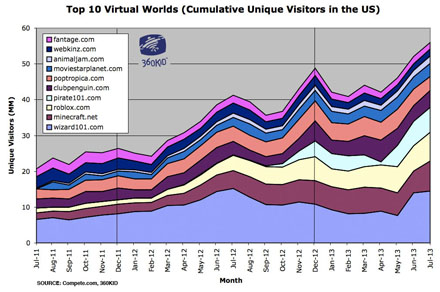
In the months leading up to last year’s Christmas holiday, at least nine virtual worlds were advertised in the US to older kids and younger tweens. These destinations included Bella Sara by Hidden City Games, Build-A-Bearville by Build-A-Bear Workshop, Mattel’s UB Funkeys, Cartoon Network’s Fusion Fall, Irwin Toy’s Me2 Universe, Disney’s Pixie Hollow, Hasbro’s MyEpets and LittlestPetShop, and Wizard 101 by KingsIsle Entertainment. Most companies offered commercial spots in 15 and 30 second lengths to promote their online virtual worlds. All commercials were placed on channels that aired children’s programming with the heaviest rotation appearing on weekends.

The company that had the most commercials in rotation was for Cartoon Network’s virtual world Fusion Fall. Cartoon Network ran an AMAZING number of spots in 10, 15, 30 and 45 second lengths to promote Fusion Fall, but all of Fusion Fall’s advertising was on a single channel, that being Cartoon Network. The shorter spots were placed strategically as bumpers around all show entry end exit points. I can’t cite the exact number, but the amount of Fusion Fall impressions per hour was impressive and more than any other competing site.

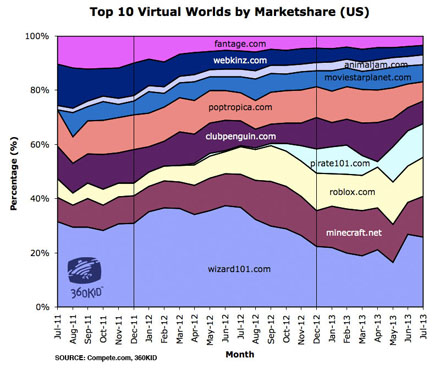
The Pixie Hollow and Wizard 101 virtual world commercials were the next heaviest in rotation after Fusion Fall, but for these worlds, they were advertised across multiple channels. Next in line was Build-A-Bearville, Bella Sara, and Funkeys. Each virtual world destination experienced an increase in unique visits to their virtual world but none more than Fusion Fall and Wizard 101 in the November to December 2008 time period. Both of these desitinations experienced an increase in web traffic 3 to 5 times more than before those on air campaigns began. All virtual worlds lost traffic to their sites after the holiday season as advertisement campaigns wound down, all except for Disney’s Pixie Hollow. However, gains remained for seven out of nine of the virtual worlds advertised when measured over a two month period, though only three out of the nine had experienced any significant gains. Out of the collection of these nine virtual worlds, seven companies offered a tangible product that was sold as part of their virtual world service.

Over the summer months, I’ve had the opportunity to check in on a few children’s channels to see what’s being advertised. A new crop of virtual world commercials are running on air this summer. One big surprise to me was MapleStory which is a virtual world that started outside the US. It makes sense to try to reach out to kids during these months to grow an audience base. I’ve been thinking that this might be a better and cheaper way to gain visibility as opposed to winning kids over during the winter holiday season.

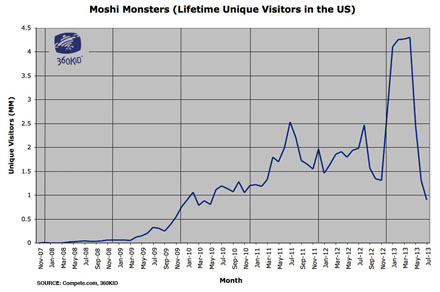
Outside of children’s television, I’ve also been keeping a close watch on a number of virtual worlds for kids. Every now and then I’m surprised by how some site just explodes. Moshi Monsters has had my interest most of this summer. This is a UK virtual world for kids that has yet to take off here in the states, but has been doing great at home. I’ve wondered why it has been so successful in the last two months. Only recently did I came across an interview with Michael Smith, CEO for Moshi Monsters on YouTube. (Thanks Joi Podgorny for the tip!) In this interview Michael discusses the growth in visitors and subscribers to his site as a direct response to advertising on TV.

If you’re interested in learning more about the data I have, shoot me an email. One thing is certain though, we should all be prepared to see many more commercials of virtual world advertised to kids in the months, and years, ahead. What used to be a vital part of toy promotion is now expanding to the virtual world as well.

Share this article...

What Works For Virtual Play? – Questions to ask about Web-enabled toys

Wednesday, May 6th, 2009

[The following is an article I wrote for Playthings Magazine which appears in the May 2009 issue.]

Photo of girl holding her stuffed animal while playing on a laptop computer

When toy companies talk about new toy products, there’s often a lot of discussion around a toy’s play patterns. What is it about the toy that resonates with a child? What play patterns will the toy tap into? Will the play pattern extend across age and gender differences?

Sometimes answering play pattern questions like these are pretty straight forward, other times their answers are not as clear cut. Potentially even more complicated is describing the play pattern around a toy product tied to a virtual world or online experience. What kind of play pattern are we talking about now? How does the play experience through an avatar in an online world differ from that of a child playing with a physical toy in the real world?

These are hard questions to answer, but they are ones I’m betting more and more people will be asking in the world of youth marketing.

The 2008 American International Toy Fair was a big year for virtual world toy products. Unlike years before, 2008 saw many virtual world product announcements, a first for the show. Some of the biggest announcements came from the likes of Disney and Techno Source with Pixie Hallow and Clickables, iToys with the Me2 Universe, Ty with Beanie Babies 2.0 and TyGirls, and 10Vox with Tracksters and KooKeys. Each of these companies offered a virtual play experience through the purchase of a tangible toy product—the business model of preference being one in which the consumer buys a tangible product that grants access to an online world.

Fast forward to 2009. It seems almost every few days we learn of a new virtual world for kids. While a number of virtual worlds were announced on the show floor during the 2009 Toy Fair, even more were announced outside of the walls of the Javits Center. What was surprising was the number of new product announcements, not just updates to old products launched a year or two prior. Take note for the future: February could very well become the product announcement month of choice in the virtual world space. Such announcements started in 2008 and today appear to be picking up steam.

As you can imagine, any announcement attached to a toy industry event will include some tangible toy product as part of the virtual world offering. Most often plush toys are the vehicle of choice for promoting virtual worlds to kids, but changes are underway within the toy-related niche of the virtual world space. Just about anything these days can include a password key on a piece of paper to allow access to an online destination. Also added to the mix are new solutions that include USB thumb drives that plug into your computer and become the keys to playing in these online destinations.

When I look back on the last two years of tangible toy/virtual world product announcements, I notice two trends, in particular, related to the software portion of the announcement:

  1. At the time when a company first makes a virtual world announcement, the virtual world is generally far from completion. If the virtual world has been in development for a long time and is in the process of a sizable public beta effort (meaning many actual consumers are testing the virtual world to flush out problems and improve the quality and stability of the product), this is a good thing. A sizable public testing effort should be the norm with all such products, but sadly it is not. As a result, first-year launches can be challenging for both the companies that make the products as well as the children who use them, typically resulting in poor reviews out of the gate.

  2. After a product has officially launched, it tends to be improved and expanded upon as sales grow or as web traffic proves what is working and what is not within the virtual world. These sorts of improvements are generally seen with products that have been in the marketplace for at least two years.

As it relates to the overall offering of both the physical and virtual parts of the product, I have these additional observations related to the buying and selling of these items that can lead to consumer success:

  • How “giftable” is the product? For example, one of the things I love about Webkinz is that the current line of plush toys makes for a great gift idea. They are priced right and are easy to give. Also, the cost to get online is attached to the purchase of the tangible item. This removes the burden from a child of figuring out how they may have to pay for the online experience.

  • Related to cost, are there any hidden fees to gain access to the online world? Sometimes the purchase of the tangible product will not allow full access online. Some virtual worlds can be tiered or gated in a way that premium content is restricted until a credit card is used. A number of different financial models exist related the sale of such products. Be sure to ask if the purchase of the tangible good is the only fee involved or if other fees are part of the online experience.

  • What kind of tangible toy selection is possible? Are there only a small number of items at one specific cost or are many SKUs available across a variety of price points? A variety of products and pricing options can be of benefit to sales.

  • Is there more to the virtual world than just game play? Few of the latest virtual world announcements offer an experience beyond games. Two products to watch that offer something more include Jacabee’s The Jacabee Code, which promotes a unique approach to learning history and Tales 4 Tomorrow, a destination that is all about animal conservation (with plush toys from Fiesta).

  • How deep is the online experience? How many activities and how much content is available? What is the mix of games to creativity tools? Newer sites may not have as much depth as sites that have been on the market for some time.

  • Who does the product appeal to, boys or girls? Historically, very few of these virtual world offerings have had an appeal to boys 9 years old and older. However, this too is changing. New destinations with a greater appeal to boys include products like the car-centric Tracksters, Revnjenz (Revnjenz) and KizMoto (KizToys); and the dinosaur-themed Webosaurs (Reel FX) and Xtractaurs (Mattel).

  • What about younger users? While it may be surprising to find even younger users interested in similar online destinations, many of the social and communication tools available to older users are just not of interest to younger users. Age-appropriate products for young users have been in short supply. However, Ganz recently announced a younger version of Webkinz called Webkinz Jr., and since 2007, Gigapals has offered an eponymously-named site with related toys for the same audience: ages 3 to 6. When thinking up products for younger children, consider the amount of reading and audio instruction provided within these worlds. This demographic may be computer savvy enough to get to your site, but they may still be challenged by the inclusion of too much text once they arrive there.

  • If the online world allows its users the ability to communicate with one another, is the method of communication “canned chat,” “filtered chat” or “open chat”? In addition, what kind of monitoring is provided to prevent inappropriate conversation or cyber bullying?

It’s hard to easily describe the appeal of online worlds for kids. An answer may be found with the sense of independence or a feeling of being in complete control over the digital universe. There might also be an aspirational component to these worlds, as well, that is hard for an adult to fully understand. Part of this new play experience may be an extension of pretend play we’re all so familiar with, related to kids and toys in the real world. One thing is certain, virtual worlds are an expanding part of a child’s play options, however you choose to define the play pattern. And because new virtual worlds are being announced more frequently, chances are there’s one that’s a perfect fit for any girl or boy, or maybe even the child at heart.

Share this article...

Growing Your Own Webkinz World

Monday, April 27th, 2009

[To read our latest interview with the creative director of Webkinz, click here.]

Three years ago I bought my then seven year old daughter her first Webkinz. She has always enjoyed pretend play offline with the tangible toy and equally enjoys the virtual play online. Both methods of play are done either with friends or alone. These days she plays in the online Webkinz universe a few times a week. She plays games, collects in-world currency called KinzCash, and builds out her Webkinz living space in the virtual world. I asked her recently if she would show me around the online world she had built for her stuffed animal friends. What I saw looked like a sizable, and very detailed build out effort she calls home for her pets. I imagine the size of this virtual home reflects her years of play online and asked her how many Webkinz she owns today. She wasn’t sure, so I suggested we find all of her Webkinz, scattered about her room and around the house, and count them. How many Webkinz plushies did we find? 26 Webkinz in all! I knew she had a good number of them around the house, but was surprised by just how many.

Multiple Webkinz plush dolls

Young fans of Webkinz have many pets in their collection. Sometimes many more than you think possible! Above is a photo of most of the Webkinz in my daughter’s collection. (Click image to see larger photo.)

She received her first Webkinz as a gift from me while I was doing research about the ever expanding online world for kids. After this flagship friend was received, a small number of birthday parties resulted in a few more as gifts from friends. A couple were even earned for successfully completing challenging at-home clean up requests. However, a majority of the Webkinz in her collection were purchased by my daughter, through diligent savings of her small weekly allowance.

If you have young children in your home between the ages of 6 to 10, chances are you’ve already heard the Webkinz buzz. While there are many tangible pets to choose from, and too many features online to count with many more being added regularly, let me pull back the curtain of this online destination to show just one small part of this universe. One central online activity includes the ability to build out a virtual home for your newly acquired animals. The more pets your child acquires, the bigger this virtual home becomes.

Multiple illustrated Webkinz animals
Illustrated translations of tangible Webkinz toys in the virtual world.

As many parents will probably already know, every Webkinz plush comes with a card that includes a secret code to gain entry into the Webkinz site. One of the very first activities you child will participate in online is decorate a place for your new pet to live. Your child will receive one “starter” room to decorate. Additional rooms can be added by either a.) saving up KinzCash by playing online games/activities to purchase additional rooms, or b.) through buying additional Webkinz in the real world. My daughter pointed out that you only get an additional room for the first ten Webkinz you buy. After that, no more free rooms. The rest can only be purchased online with KinzCash.

Map of multiple Webkinz homes next to each other

This map, stitched together from multiple screen captures taken within the Webkinz World, shows all of the rooms that have been purchased and designed within my daughter’s collection of Webinz online. She started with just one room and built out this large living space for all of her pets. Clicking on any one of the squares from this map within the Webkinz World will bring you into an orthographic view of the individual room itself. Note the different sizes and themes to each room. (Click image to see larger photo.)

Rooms can be decorated with a wide selection of items for purchase through the WShop, the online equivalent of a home furnishings store. There are plenty of items available to spark a child’s decorative imagination. Chairs, beds, games, TVs, wall paper, you name it. Also, some of the items you can acquire are considered “exclusive” and are only made available from “adopting” your 10th, 15th, 20th (etc.) pet. (Translation of adopting — the purchase of additional Webkinz in the real world.)

The WShop within the Webkinz World

The front step to the WShop which displays all the different categories of home furnishings you can buy within the Webkinz World. Selecting a category will bring you deeper into the store, showing the store visitor pictures of the item they may wish to place within one of their pet’s rooms. (Click for larger individual images.)

There are three different room sizes and a small number of different themed rooms. For example, you can purchase themed rooms that reflect a certain holiday, like Halloween, or if your pet lives underwater you can purchase a water room. Your pet moves around the room by clicking on an invisible tile matrix that covers the floor of the room. Large rooms are made up of a 10 x 10 grid. There are also medium sized rooms, 7 x 7, and small rooms, 5 x 5. This grid system also helps with the positioning of items purchased from the WShop within the room.

The three main room sizes in the Webkinz world

There are three main room sizes available in Webkinz World and a variety of different themes as well. If one of your Webkinz is a fish, chances are you will want a water room. Ask your child what happens when a non-water animal enters a water room. (Click for larger individual images.)

I’m fascinated with the technical logistics of this room making activity within Webkinz. There are a number of individual parts that need to work perfectly together, and need to scale just right with every new addition to your child’s collection. If your child is a Webkinz fan, ask them how many pets they own. Ask your child’s friends as well. You may be surprised at the answer! I’m amazed at the number of Webkinz my daughter’s friends own. Just this week we met a new friend that had over 20 Webkinz in her collection. One boy in the neighborhood who she sometimes plays with boasts owning 46 Webkinz! What sorts of stories about Webkinz do you hear from your children? What do they like best about Webkinz? How many pets do they own? Thanks for reading and for sharing your comments below!

Share this article...