

Monday, November 26th, 2007
As I was preparing my presentation for the Dust or Magic conference mentioned in my previous post, I couldn’t help but notice how much new activity there is in the kids’ social networking world. As the researcher Peter Grunwald shared with me last month, social networking as a concept has always been available on the Internet. Even so, it seems to have some newer meaning in the context of an activity kids express interest in. Last year at this time, I was only familiar with maybe four sites for kids. Fast forward a year, and I am amazed at how many more companies are playing in this space, some of which have been around for years but are only now gaining visibility. Not all of these sites are of equal quality and, right or wrong in their approach, each has a different set of assumptions about how to engage children. Below is a list of the social networking websites I am aware of today. It is not a complete list. My definition of social networking sites is a little broad, but there’s no denying the growth in this space.
| Site | Launch | Site | Launch | Site | Launch |
|---|---|---|---|---|---|
| BarbieGirls | Apr 2007 | Mokitown | Jul 2001 | SuperClubsPlus | Apr 2006 |
| Be-Bratz | Aug 2007 | MyNoggin | Oct 2007 | ToonTown | Jun 2003 |
| CityPixel | Sep 2006 | Neopets | Nov 1999 | Webkinz | Apr 2005 |
| Club Penguin | Oct 2005 | Nicktropolis | Jan 2007 | Whyville | Mar 1999 |
| Club Tuki | Jul 2007 | Panwapa | Oct 2007 | YoKidsYo | Dec 2006 |
| Gaia Online | Feb 2003 | Postopia | Apr 2001 | Yomod | May 2007 |
| Habbo Hotel | Aug 2000 | PuzzlePirates | May 2002 | Zwinktopia | May 2007 |
| imbee | Jun 2006 | Runescape | Jan 2001 | – | – |
| Millsberry | Aug 2004 | StarDoll | May 2004 | – | – |

By graphing these sites by the year in which they launched, one begins to see the growth trend of social networking websites for kids.

Since March of this year, my company, 360KID, has received a number of requests to build new social networking websites. More calls started coming in after the Club Penguin acquisition by Disney. Some people who call are driven by one thing- to create a Club Penguin-like website that’s better than Club Penguin. While Club Penguin has many great things going on within its service, there are certainly other avenues within the social networking world to explore. After comparing different sites currently available for kids, I see many unique opportunities to take advantage of, especially ones that touch on different areas of learning. Below is a matrix showing different content segments and age groups that are covered (or not) within the social networking world.

The blue shading indicates age groups that are less motivated by social features but are interested in community-based activities. Companies listed in italics offer activities that are much more community than socially driven.
While reviewing all of these sites and speaking with many different people interested in building social networking sites for kids, I have put together a short list of do’s and don’ts that put the interests of the child first and will ultimately create more successes with your intended audience:
- Don’t design by committee – Keep the integrity and the strength of your design strong by defining with small teams. Have anywhere from one to three strong visionaries of equal voice define the broad strokes of your product.
- Be open ended in your design – If you can avoid it, don’t force children to play in a specific way. Think how you can allow for multiple ways for children to interact and play within your environment.
- Think emotional connection – Offer activities or avatar characteristics that will create a sense of empathy with your user.
- Design for a very specific audience – Pick a specific age range, like 3 to 5 or 7 to 9. Then learn as much as you can about that audience, like its developmental strengths, play patterns, interests. Don’t design a product with the intent of appealing to a large age range, like 3 to 300. Designing for a broad audience tends to have the outcome of appealing to no single group.
- Competing against a community vs. competing against yourself – I’m asked a lot about my thoughts related to leader boards, which are areas of gaming sites in which the top score places high on a list of other members of a community. While I understand the motivation of leader boards for certain audience segments as a motivator, a game mechanic like a leader board, can also turn away other audience types. There are some instances where leader boards can be used effectively, like in classroom vs. classroom competitions, but generally, I am opposed to using such features, especially when a desired outcome is informal learning.
- Text – I am continually surprised as to how often a web product designed for very young children doesn’t take into consideration that their audience may consist of prereaders or emerging readers. Be thoughtful with your use of text and instructions. Consider visual, iconic, or audio instructions as opposed to text with younger audience members.
Is this race to develop social networking sites for kids a boom or a bubble? If you asked me a couple of months ago, I would have said a bust is on the horizon in this space. But the more I think about it, the more I’m seeing a new play pattern emerging which kids will really enjoy when developed correctly. That doesn’t mean that everyone will succeed. There will be many failures and few successes, but I believe the future successes will keep this sector of interactive products for children growing strong for many years to come.
These are a few thoughts I shared in my recent presentation at the Dust or Magic conference. To see the full presentation I delivered, you can view a video of my presentation below.
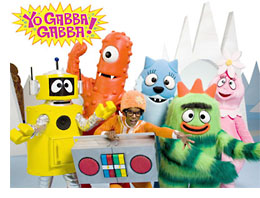 The long awaited debut of
 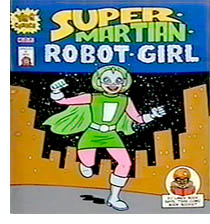 The first season of Yo Gabba Gabba will include 20 episodes. Much like any new show, it takes some time to hit your stride and find that natural beat. The first few shows are good; some parts are stronger than others in their appeal, but an improvement in show quality can be seen from episode to episode. The second show, themed “Summer”, is very entertaining. The performance by the band The Aquabats with their song “Pool Party” has made me an instant fan of the group. A segment called “Cool Tricks” where kids (and sometimes adults) show off a unique skill they have learned, and a re-occuring animation segment called “Super Martian Robot Girl” are also very entertaining. I thought this show was good, and then I saw the fourth episode called “Dance”. It was just plain rockin’ with great rap music, a “red-light, green-light” approach to dancing for youngsters, and striking video effects that made me feel like going out to a the dance club! I’ve seen a wonderful progression in the quality of music over this short span of shows and am eagerly awaiting more of the same with shows yet to air.
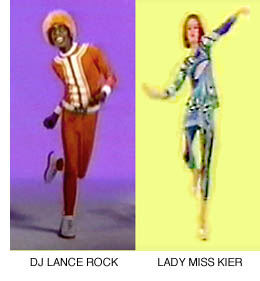 Whether intentional or not, you can see many other influences on the show. The main sets and some of the characters found in Yo Gabba Gabba have a
 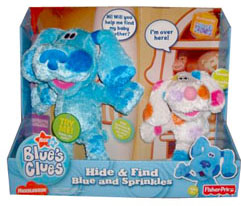 I’ve been wondering when RFID would begin to take a hold in the toy market. RFID is a technology that takes advantage of small wireless computer chips that have the ability to talk to one another. One way of thinking about the technology is that if a shirt had an RFID tag in it, whenever you dropped off the shirt at a dry cleaner, the radio frequencies emitted by the tag would alert some other computer in the store; it would know instantly who you are and how you would like your shirt laundered without ever saying a word to anyone. RFID allows any two (or more) items embedded with the technology to know about each other, and know how far away they are from each other. RFID used within toy products has the wonderful ability to work with the way children naturally play, and also offers new and imaginative enhanced play opportunities. Imagine a toy house complete with furniture, different dolls of family members, pets and vehicles that all could be electronically aware of each other. As the dog approaches the boy doll, the boy could speak the dog’s name. As a car drives up to the house, its headlights could turn on. As the mommy doll enters the front door, it could speak “Kids, I’m home!”