Archive for the 'Age 08-10/Grade 3-5/Tween' Category

Wednesday, February 14th, 2007

It’s that time of year again in New York City, which means there’s either a huge snow storm brewing or the newest crop of toys can be seen at Toy Fair. After being at the American International Toy Fair for the last three days checking out the latest technology toys, I’ve seen a few noteworthy trends to watch:

  • First, there are indeed more technology toys at this year’s show than last year, including technology products coming from traditional toy companies that have not yet played in the technology space
  • Plug-and-play devices, which were in great abundance last year, are less noteworthy this year
  • Of those few remaining plug-and-play products, the new trend is to make plug-and-play toys that connect to the USB port of your computer instead of a television set
  • And finally, guitars will be big business by holiday of 2007

When I go to toy fair I look for two things: technology and learning. Toys that use technology to deliver learning opportunities is what gets me excited about the show. When you think about technology toys and learning, the usual suspects come to mind: Fisher-Price, LeapFrog, and VTech. What was unusual about this year’s toy fair is that LeapFrog was nowhere to be found. They did not exhibit at the show. None-the-less, new products were announced by all. Over the next few days I will describe some of the highlights within tech toys, as well as a few other surprises in the coming days, but today… let’s start with just the guitars:

I Can Play Guitar by Fisher-Price
I Can Play Guitar photoFollowing on the success of I Can Play Piano, the TOTY (Toy of the Year) nominated product that helps kids learn to play the piano, Fisher-Price has released this new product to help kids learn to play guitar. I Can Play Piano has a wonderful method for teaching how to site read music and translate that knowledge to keyboard playing. I didn’t have the opportunity to play with the new I Can Play Guitar product first hand, but look forward to seeing it’s instructive solution. This was one of the few TV plug-and-play products at the show and the only new guitar product that uses a screen. It’s intended for kids ages 5 and up.

Power Tour Electric Guitar by Hasbro

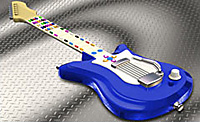
Power Tour Electric Guitar photoThis technology toy is not intentionally positioned as a learning product, but it’s bound to influence kids to want to play guitar. This electronic toy teaches kids how to play 12 different songs but also allows an MP3 player to be hooked up to the guitar as well to play along with your favorite tunes. Lights on the fretboard appear to let the user know where to place their fingers. The device also has audio in and out ports. Hasbro worked with the guitar maker Gibson to make this product. Hasbro believes this toy will have a strong appeal to tweens.

Learn & Groove Animal Sounds Guitar by LeapFrog
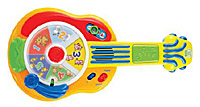
Learn & Groove Animal Sounds Guitar photoThis digital guitar, complete with whammy bar and buttons on it’s fret. It not only allows for musical exploration but also introduces numbers, letters, and animals in both English or Spanish. It’s suggested use is for infants and toddlers ages 12 to 36 months.

Electric Rockerz Guitar by Zizzle
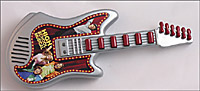
Electric Rockerz Guitar photoThis guitar is not meant to assist with learning but joins the digital guitar bandwagon. This product is the smallest and least expensive of the bunch and promotes the sequel to the Disney Channel TV movie High School Musical. It too targets tweens and is part of a collection of electronic toy instruments that will appear on store shelves later this summer.

Jam With Me Electric Guitar by KidDesign Little information is available about this digital toy but what we do know is that it has a slot to plug in an iPod Nano.

While marketers imply these toys are inexpensive ways to introduce guitar playing to kids without the price tag of a real guitar or lessons it’s more likely they’re now appearing as a result of the smash success with the video game Guitar Hero and Guitar Hero 2. The only learning that occurs in these PS2 titles is hand-eye coordination and timing, but after 30 minutes of play with these titles, or maybe with these new guitar toys, you too will want to brush the dust off of your Mel Bay guitar instruction books!

Next up, I’ll take a look at more non-musical plug-and-play products debuted at Toy Fair.

Average Rating: 4.5 out of 5 based on 183 user reviews.

Wednesday, January 31st, 2007

Nickelodeon recently released a new study that looks into technology use by kids ages 8 – 14 and parents of kids ages 0 – 14. This new report called The Digital Family is mentioned as a follow-up to an earlier Nickelodeon report released in 2006 called Living in a Digital World which cited that 86% of kids ages 8 – 14 are playing video games online. While this earlier report has some very interesting findings about kids and video game, television, instant messaging and chat room use, the publicly available findings are not necessarily data rich. However, this new report is chock-full of great stats, providing excellent insight into Internet, cell phone, television and MP3 player use.

Among the key findings in this study, kids, as well as parents, report:

  • a decline in the use of and a reliance on newspapers, maps, and dictionaries because of the availability of information found on the Internet
  • a decline in radio listening as a result of MP3 players
  • a continuing and growing interest in TV viewing and use of TV as a means to relax and unwind
  • a declining interest in purchasing of music albums and CDs
  • safety and piece-of-mind from owning a cell phone
  • the empowering, creative, and educational benefits of having access to the Internet
  • parents using the Internet over 33 hours a month and kids using the Internet more than 19 hours a month
  • parents being just as tech savvy or even more so than their children

What this report calls into question is:

  • older incorrect assumptions about digital media use and digital media consumption by kids and adults
  • shifting perceptions about what is “important knowledge”
  • traditional school skills being outdated
  • the value of older print-based media and radio
  • traditional music and information distribution method
  • incorrect perceptions about parents ability to keep up with kids when it comes to technology

Technology and the Internet continue to change the world of kids as well as parents in amazing ways. And surprisingly television looks like it will be the only older media format to have ongoing staying power for young and old. But if there’s one thing you can rely on as a result of this study’s findings is that more change in our future… change with how technology will impact media consumption, communication, learning, family dynamics and wider social interactions. Assumptions about the way things have always been are being challenged in a significant way. The rules of child engagement are being rewritten right before our very eyes.

To read the full Nickelodeon Press release, and see the wealth of stats, click here.

Average Rating: 4.5 out of 5 based on 300 user reviews.

Tuesday, November 28th, 2006

Nickelodeon and MTV recently announced their findings from their Wellbeing Study of kids and young people across the globe. The study looks at differences and similarities with today’s youth across fourteen different countries. The data collected in this study reveals noteworthy differences between developing nations (Argentina, Brazil, China, India, Indonesia, Mexico, South Africa) and developed nations (Denmark, France, Germany, Japan, Sweden, UK, US). This study groups its participants into two major demographics; kids ages 8 – 15 and young people ages 16 – 34. Removing the research findings for young people to focus just on the findings for kids the following observations appear…

Experiences that all kids share:

  • Kids are growing up younger and appear to be experiencing higher levels of stress in their daily lives
  • Kids across all ages and in every country feel pressure to succeed
  • In 12 out of the 14 countries surveyed, two thirds of kids said that getting good grades in school was their top priority
  • The more news media outlets a nation has, the less safe kids feel regardless of where they come from in the world

Experiences that are different for kids in developing nations versus their counterparts in developed nations:

  • Kids in developing nations feel more positive about their future than kids in developed nations. They are also happier and expect to have more fun in their future
  • Kids in developing countries expect to earn more than their parents, while kids in developed nations expect to earn less than their parents
  • Bullying happens everywhere but it’s generally more of a problem in developed nations than in developing nations
  • Kids in the developing world are more patriotic than their counterparts in developed nations

What is noteworthy about this study is how MTV plans to use this research to generate new programs for young people ages 16 – 34. For example, one noteworthy concern for all young people across all nations is the worry about jobs and working. As a result, MTV plans to develop programs specifically for this demographic that demystifies the job market.

What insight is unveiled here for kids ages 8 – 15? What content could be created that would appeal to a broad base of kids everywhere? Certainly creating content that informs kids about media literacy skills and strategies to feel safe in their surroundings. If getting good grades in school is a major concern for all, what content could be created that empowers kids to be better learners? How can you create a lifelong love of learning with this information? While the findings suggest a path for how to make content more relevant, and possibly more appealing to kids, translating that relevance into successful content is the challenge. While the available data is limited, it defines universal issues important to kids and important to include in all new product development.

Average Rating: 4.4 out of 5 based on 299 user reviews.