

Monday, May 28th, 2007
Robin Raskin, featured columnist for Yahoo Tech and youth technology expert for many nationally syndicated newspapers and magazines, was recently in my area speaking about Internet safety and kids. There were about 300 people at the presentation. Half of the group were sixth graders (ages 11 – 12), the other half were parents. The event was held at a local university just outside the Boston area.
I’ve heard Robin speak many times about technology. Her latest presentation, as always, was great. She pointed out all kinds of Internet safety tips of benefit to both parent and child. Robin did not shy away from the tough topics to discuss with kids like online predators, scams, identity theft, and pornography. She offered some excellent advice about what kids and parents can do, both together and apart, to avoid being taken advantage of or exploited in this ever changing digital world.
One part of her presentation left me thinking long after its completion. It started when Robin asked the kids in the audience a few questions. The first was “How many “texters” do we have here in the audience?” (Or how many kids communicate with text via instant messaging or by cell phone?) Practically no parents raised their hands but more than 60% of the kids responded yes. This first question made it quite clear that computers and cell phones are common communication tools for both young and old, but each group uses these technologies to communicate in significantly different ways.
After the show-of-hands about texting, a couple more questions were offered. “How many of you use the social networking site Club Penguin?” Surprisingly, only about 8 hands went up in the audience. This question was followed up by “How many of you use Webkinz?” This time, only about four kids raised their hand.
In this day, it’s pretty hard not to know about these two successful social networking sites for kids. Club Penguin first came on the scene in 2005 and states that it’s an online service for kids ages 8 – 14 ( grades 2 – 8 ). Webkinz also started in 2005 and claims it’s target audience is for kids 6 – 13 ( grades K – 7 ). Social networking sites for kids are growing very fast in their appeal. Other kids’ social networking sites beyond these two include such destinations as imbee, Runescape, StarDoll, BarbieGirls, and Whyville. (Whyville being the strongest educational player of the bunch. To read additional thoughts I have about Whyville, take a look at a recent interview I had with a Boston area online magazine for tech saavy women called Misstropolis.)
The number one most popular destination for kids online today is Webkinz as reported by HitWise (HitWise is one of many different web research services available to businesses). Nieslen//NetRatings, another web research firm, reports that Webkinz had 3.6 million unique visitors in April 2007 with Business 2.0 Magazine reporting an average visit length of 128 minutes long. Those are some pretty impressive stats! As for Club Penguin, their numbers are equally impressive. Nielsen//NetRatings reports Club Penguin as having 4 million unique visitors in April 2007, with the Business 2.0 Magazine article also citing the average visit being 54 minutes long. Not too shabby!
So, if these two extremely popular websites for kids overlap nicely with the sixth grade demographic in the audience, why weren’t more hands raised? I found the response by this group of kids fascinating. Assuming that all the students heard the question, and I believe they did, here are a few theories:
- As these social networking sites begin to age, the target demographic shifts younger, from tweens 8-12 (grades 4 – 6) to kids ages 5 – 9 (grades K – 3). This may imply that when a new kids’ web destination first becomes available, an older demographic will lead in the use of these sites more often than their younger peers. As more and more younger users discover the product, the older crowd moves on to find the next new destination.
- As older tweens enter into their early teen years, it’s possible there’s a negative stigma attached to publicly admitting the use of these sites even though privately this older audience will continue to spend time at these destinations.
- It could be that sixth graders in urban areas may not be using these specific social networking sites as much as those in suburban areas. I wonder if it’s possible that the likes and dislikes of kids from the same age group in urban versus suburban areas or coastal versus heartland parts of the country differ from one another.
- It’s possible these sites never did have much appeal for an older audience as originally claimed by the owners of these companies (though I doubt this.)
- Or maybe the answer lies in some combination of the above or other possibilities yet to be defined.
Whatever the answer, it’s amazing to see how the responses of kids answering as a group might differ from that of carefully analyzed web data and claims from many individual users of the same demographic (in the same geographic location).
 If I could take just one toy home that I saw at Toy Fair, it would be this one. (Remember, I spent three days at the show and saw LOTS of new products). In a tiny little booth, way in the back of the Javits Center, far off the beaten path, I discovered this gem. It’s a remote controlled butterfly that actually flies. While this product is not positioned as a learning product, I see all kinds of home and classroom discussions opportunities about the history of flight, butterflies, metamorphosis, technology and more. At the time of this blog post, the company’s website has not been built, but for those interested in learning more you can email inquiries to: info (at) supercreation (dot) com (dot) hk. Click
  Braincandy is a young company specializing in making DVD and audio CD products for very young children. Currently they have two DVD products available that help children learn about themselves through their flagship title that focuses on the five senses; a second is all about sight.
 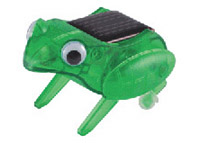 OWI is a technology toy company that specializes in offering small robotic science kits. This year they unveiled a number of new solar powered critters. To assemble, simply snap together all of the electronic parts. No soldering is required. Then you can watch them move when a light source is made available to power their motors. While you cannot currently purchase these items through the OWI website, I’ve provided links here to another distributor where you can purchase the four robots demonstrated at the show; a
  Leveractive has succeeded in creating two very engaging and very playful CD-ROM titles specifically for babies (and their parents). Two different titles, one called Shapes, the other My Animal Friends, allow babies to hit any key on a computer keyboard to bring up many fun animations, music and sound effects. The developers have made sure that there’s no way a baby can accidentally hit key combinations or the Escape key to cause havoc at the desktop level. Each title contains 14 charming activities. The content is very age appropriate and also offers English and Spanish set-up options right on the same CD.
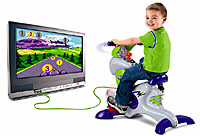 There was much buzz at Toy Fair with the announcement of this toy and rightly so. The Smart Cycle is a TV-based plug-and-play, cartridge-based platform that looks a like a cross between an exercycle for preschoolers and a
 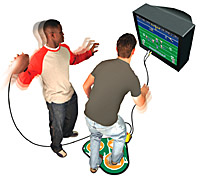 Here are two new plug-and-play products to come out of Radica, a cool tech toy company now owned by
  Hyper Dash is a technology toy that could be used indoors or out and does not require a television or computer to use. To start the game, 5 colored electronic targets are placed around the house or yard. Then, holding a talking electronic “tagger”, spoken instructions are given to the child, like find the blue target, then the red, etc. There are different game settings that focus on math skills, team work, and timed-based searches. As a child successfully finds the requested target, the music, pace, and complexity of each new request increases. This toy is recommended for children ages 5 – 8.
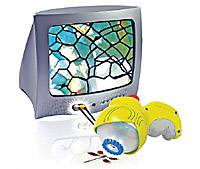
 The company TikTokTech was showing two different stand alone TV plug-and-play devices. A small camera unit is placed on top of your television to play either music games or a combination of music and art games, depending on which device you purchase. While motion-based products have really only been around for a short while, these are the only titles available that provide a freeform artistic or musical experience for kids. For those that follow motion-based games, I strongly recommend checking out the
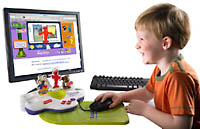
 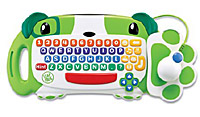 The ClickStart plug-and-play toy provides young children the experience computing in a fun and safe way, without tieing-up mom or dad’s home computer. This product includes a child-friendly keyboard and mouse, which can be set up to accommodate left or right handed users. The on-screen learning is guided by a friendly puppy named Scout. Children collect food treats for Scout as they complete games using numbers, letters, shapes and colors. This toy is a cartridge-based platform which means you can expect to see a number of different titles available to use with the base unit later this year. ClickStart is intended for children ages 3 – 6.
 The Easy Link Internet Launchpad acts like a mom-approved dashboard to preschool-safe content on the web. Say a child would like to visit their favorite Sesame Street online game. All a child needs to do is pick up one of the many miniature figurines, in this case Elmo ( or Barney, Clifford, the Wiggles, Thomas the Train, Bob the Builder, and others) and place the figurine in its designated spot… a little like placing the round peg in the correct hole. Once inserted, the device automatically will link its user to the games section of sesamestreet.com. No typing is necessary and all content locations are child-safe with no external links to undesirable content. This product works best with children ages 3 – 6.
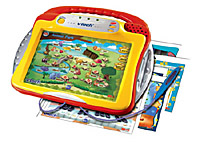
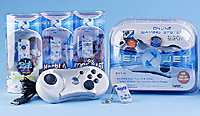 NetJet is a clever USB connected handheld device created by Tiger Electronics, a division of Hasbro. NetJet consists of a handheld game controller and a game key. Each game key inserted into the controller allows its user to access different casual game content online. Popular games using familiar characters and brands are available through this device, but not to those without the controller and keys. The NetJet environment is also free of advertising. No banner of pop-up ads here. Kids are also kicked offline once the NetJet device is removed from the USB port. By this coming fall season, 40 different casual game titles will be available for purchase. This product will appeal to casual gamers, both young and old, but Tiger is best know for their success with the tween market. This is not a learning product, but NetJet is an excellent use of plug-and-play technology.
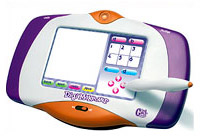 This TV plug-and-play device first appeared at last year’s Toy Fair. It has a built in camera which allows it’s user to take a picture of oneself, then, through the controls on the tablet, modify hairstyles, add jewelry, and apply makeup. (Note: This product has brought about much discussion in our office about female stereo-typing and the kinds of messages it sends out to young girls. In our own testing of the product, we find that kids enjoyed the product greatly when we referred to it as a “stuffed animal makeover” toy. Kids couldn’t stop laughing when they gave a giant stuffed Pikachu and other fuzzy friends a new hairdo and pearls!) What’s new here is Radica has hinted it will be releasing an newer version of the device later this year but no formal announcement has been made.