

Monday, February 19th, 2007
As a nation we are gaining a greater awareness to the dangers of a sedentary lifestyle and unhealthy eating choices. The CDC reports that approximately 30% of kids ages 6 – 11 are overweight. Because my company is involved with the development of learning products for kids I’m noticing more businesses and schools paying closer attention to what they can do to be a cause for better eating choices and physical activity in a child’s daily life. I’m seeing makers of children’s television programs find ways to reach out to kids about the benefits of exercise. (Take a look at the show Lazy Town on Nick Jr. or have you noticed how Cookie Monster has changed his eating habits to be more balanced?). Great success is also occurring in the video game sector to get people off the couch and moving, with platforms like Nintendo’s Wii, dance pad products like Dance Dance Revolution and other products like Sony’s EyeToy and Hasbro’s iOn.
Soon you will see more toy companies offering technology products to get kids moving and active. Here are a few noteworthy items I saw at Toy Fair:
Smart Cycle by Fisher-Price
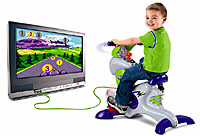 There was much buzz at Toy Fair with the announcement of this toy and rightly so. The Smart Cycle is a TV-based plug-and-play, cartridge-based platform that looks a like a cross between an exercycle for preschoolers and a Big Wheels, but it’s also a video game. Once the Smart Cycle is hooked up to your television, children begin peddling and can steer the handlebars to select objects displayed on the screen. Biking quests can include finding letters of the alphabet, shapes, and exploration of other early learning concepts. This product is destined to be a multi-award winner and influencer on the next generation of motion-based products. Children, ages 3 – 6, will love this product. Sadly adults will be challenged to fit into this bicycle seat!
Play TV MLB Baseball and Play TV Football 2 by Radica
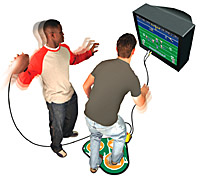 Here are two new plug-and-play products to come out of Radica, a cool tech toy company now owned by Mattel. The first, Play TV MLB Baseball comes with a bat you can swing and a ball to throw. Each item has motion sensitive electronics inside which feeds information back to your TV set. Play TV Football 2 (not to be confused with last year’s release, Play TV Football) has the same tech in a football. Your teammate runs on a small pressure sensitive mat to control characters on screen to catch the pass. Both products appear to be targeting a tween audience.
Hyper Dash by Wild Planet Entertainment
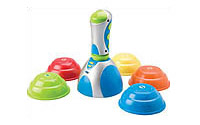 Hyper Dash is a technology toy that could be used indoors or out and does not require a television or computer to use. To start the game, 5 colored electronic targets are placed around the house or yard. Then, holding a talking electronic “tagger”, spoken instructions are given to the child, like find the blue target, then the red, etc. There are different game settings that focus on math skills, team work, and timed-based searches. As a child successfully finds the requested target, the music, pace, and complexity of each new request increases. This toy is recommended for children ages 5 – 8.
Motion-based Music and Games by TikTokTech
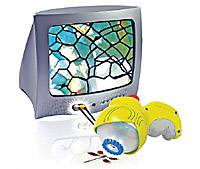
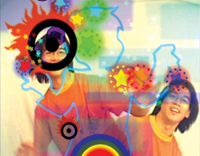 The company TikTokTech was showing two different stand alone TV plug-and-play devices. A small camera unit is placed on top of your television to play either music games or a combination of music and art games, depending on which device you purchase. While motion-based products have really only been around for a short while, these are the only titles available that provide a freeform artistic or musical experience for kids. For those that follow motion-based games, I strongly recommend checking out the user testing videos posted at the IF Media Lab website. IF Media Lab appears to be the technology and research arm for TikTokTech. These two titles are recommended for kids ages 3 – 8.
In my next post, I’ll share with you a handful of surprises that caught my eye at Toy Fair. These finds may not make big headlines, but they have enough magic in ’em to make them stand out in a crowd.
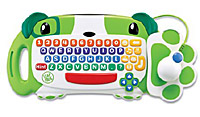 The ClickStart plug-and-play toy provides young children the experience computing in a fun and safe way, without tieing-up mom or dad’s home computer. This product includes a child-friendly keyboard and mouse, which can be set up to accommodate left or right handed users. The on-screen learning is guided by a friendly puppy named Scout. Children collect food treats for Scout as they complete games using numbers, letters, shapes and colors. This toy is a cartridge-based platform which means you can expect to see a number of different titles available to use with the base unit later this year. ClickStart is intended for children ages 3 – 6.
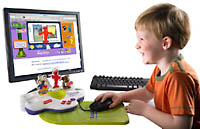 The Easy Link Internet Launchpad acts like a mom-approved dashboard to preschool-safe content on the web. Say a child would like to visit their favorite Sesame Street online game. All a child needs to do is pick up one of the many miniature figurines, in this case Elmo ( or Barney, Clifford, the Wiggles, Thomas the Train, Bob the Builder, and others) and place the figurine in its designated spot… a little like placing the round peg in the correct hole. Once inserted, the device automatically will link its user to the games section of sesamestreet.com. No typing is necessary and all content locations are child-safe with no external links to undesirable content. This product works best with children ages 3 – 6.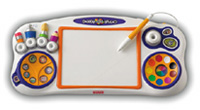
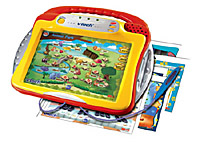
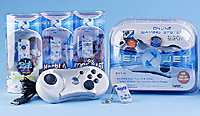 NetJet is a clever USB connected handheld device created by Tiger Electronics, a division of Hasbro. NetJet consists of a handheld game controller and a game key. Each game key inserted into the controller allows its user to access different casual game content online. Popular games using familiar characters and brands are available through this device, but not to those without the controller and keys. The NetJet environment is also free of advertising. No banner of pop-up ads here. Kids are also kicked offline once the NetJet device is removed from the USB port. By this coming fall season, 40 different casual game titles will be available for purchase. This product will appeal to casual gamers, both young and old, but Tiger is best know for their success with the tween market. This is not a learning product, but NetJet is an excellent use of plug-and-play technology.
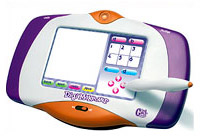 This TV plug-and-play device first appeared at last year’s Toy Fair. It has a built in camera which allows it’s user to take a picture of oneself, then, through the controls on the tablet, modify hairstyles, add jewelry, and apply makeup. (Note: This product has brought about much discussion in our office about female stereo-typing and the kinds of messages it sends out to young girls. In our own testing of the product, we find that kids enjoyed the product greatly when we referred to it as a “stuffed animal makeover” toy. Kids couldn’t stop laughing when they gave a giant stuffed Pikachu and other fuzzy friends a new hairdo and pearls!) What’s new here is Radica has hinted it will be releasing an newer version of the device later this year but no formal announcement has been made.
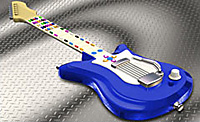 Following on the success of
  This technology toy is not intentionally positioned as a learning product, but it’s bound to influence kids to want to play guitar. This electronic toy teaches kids how to play 12 different songs but also allows an MP3 player to be hooked up to the guitar as well to play along with your favorite tunes. Lights on the fretboard appear to let the user know where to place their fingers. The device also has audio in and out ports. Hasbro worked with the guitar maker Gibson to make this product. Hasbro believes this toy will have a strong appeal to tweens.
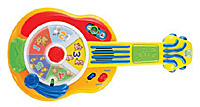 This digital guitar, complete with whammy bar and buttons on it’s fret. It not only allows for musical exploration but also introduces numbers, letters, and animals in both English or Spanish. It’s suggested use is for infants and toddlers ages 12 to 36 months.
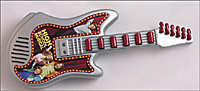 This guitar is not meant to assist with learning but joins the digital guitar bandwagon. This product is the smallest and least expensive of the bunch and promotes the sequel to the Disney Channel TV movie