My company, 360KID, watches over trends in the kids’ space very closely; it’s one of the things we do best. We know our end users, and we follow the research that helps support new trends yet to be pioneered. 360KID also keeps a close eye on technology, gaming, education, and generational trends because what happens in these additional areas also has an impact on children’s lives. What trends are we currently watching and projecting five years out? Specific trends in the technology space include: social networking, toys, video games, education, and computing.
Social networking sites are currently the biggest and hottest trend for kids today. They’re great destinations for growing virtual communities. A few of the most popular online destinations include Club Penguin, Star Doll, Barbie Girls, Webkinz, and Runescape to name a few. As social networking services and products continue to evolve, and specific kid-focused enterprises use social networking technologies as a powerful tween connector, new social networking capabilities yet discovered will be combined to create even more engaging, lasting, and sticky experiences for kids. Currently, social networking is confined to a computer/Internet experience, but it could be possible for this form of entertainment to migrate to cell phones. More than 27% of kids ages 8 – 12 have their own cell phone. That number is expected to double by 2010. However, due to a lack of cell phone technology standards within the US, social networking technologies may not become commonplace on all cell phones unless the technology landscape shifts. For example, if the FCC made analog television signals available for non-emergency network uses through wireless everywhere initiatives, this could ultimately benefit not just computer experiences, but also cell phones and other tech devices.
The toy industry within the US will continue to hover at the $22 billion mark in the years ahead, but what will change is one specific segment of the toy industry, that being the youth electronics category. This year the NPD Group, a leading research firm in the video game and toy industries, projected a 23% growth in youth electronics. (Youth electronics is just one of 11 different “supercategories” in the toy space. Other supercategories include action figures, arts & crafts, dolls, vehicles, etc.) Many experts in the toy industries, as well as the electronics world, believe the toy industry is transforming into its own unique consumer electronics industry. While it’s expected that many popular technology toy products like digital games and plug-and-play TV toy devices will continue to deliver their “toy” magic, microprocessors are finding their way into My Little Pony dolls, Hot Wheels toys and many other traditional, non-technical toy products. Those in the toy industry often refer to Moore’s Law, the idea that microprocessors double in computer processing power every 24 months, as being on steroids in the toy space. An “echo” of this law, starting with the oldest and cheapest microprocessors, is working its way into everyday technology kids use every day.
Another technology trend that will have significant impact on computing, technology toys and technology used in the classroom is the One Laptop Per Child (OLPC) initiative, sometimes referred to as the $100 laptop. This has been spearheaded by Nicholas Negroponte at MIT’s Media Lab. The goal of OLPC is to put a low cost laptop in the hands of every child on the planet for educational purposes (every child that is except those found within the US.) The number of laptops OLPC wishes to give away is 150 million units. By this coming fall season, the first 3 – 5 million, low cost laptops (averaging $175 per unit) will begin shipping to early adopter countries around the globe. Even if the OLPC initiative only partially succeeds, its boldness is forcing many companies (Microsoft with the Student Innovation Suite, Intel with the Classmate PC, Dell, Gateway and others), institutions (US Department of Education and other education institutions and ministries around the globe), and even toy companies to rethink everything. For example:
- Will OLPC create consumer demand for powerful computers that cost less than $100?
- Since education within the US is in drastic need of an overhaul, how will the constructionist learning approach surrounding OLPC laptops influence the institutionalized instructivist conversation within the US?
- Since OLPC is an open platform relying primarily on an open source operating system and software, how will this influence consumer-based operating systems and consumer software as we know it?
- If a reasonably powerful computer can be created for $100, can an electronic toy manufacturers create a powerful toy computer for $50? Could there someday be such a thing as Winnie the Pooh’s first computer that’s affordable and actually works like a real networked computer?
The video games industry, and specifically momentum currently being experienced in the Learning Games or Serious Games sector of the video games industry, is an important trend to follow. Many noteworthy academics and consumer video games experts are all exploring video games as a vehicle for learning. While great strides have been achieved in the last three years, this movement is still relatively young in it’s history. What’s exciting to watch is the number of video game companies exploring new ways to deliver learning messages and educational content. What is learned in this specific video game sector has great implications about what kinds of learning material might more easily be learned in the future. And as kids young and old spend more time playing video games with every passing year, this movement suggests how future tech savvy youngsters might be spending their free time.
The education sector continues to feel accountability pressure from the No Child Left Behind (NCLB) mandate. Even if this mandate is not reauthorized this year, 33% of the teacher work force (aging baby boomers) are planning to retire within 5 years, and the attrition rate for new teachers continues at its current level of 50% within 5 years for all new teachers. If these two trends are combined with the small projected spike coming in the student population, class sizes will grow as the availability of experienced teachers shrinks significantly.
In order for teachers to help each of their own students learn according to their own individualized needs, technology in the classroom will prove to be an essential component of everyday instruction. Future products will not just provide individual, classroom, school and district wide achievement data, but it will also allow for a level of customization and individualized instruction that is badly needed in today’s education environment.
One thing becomes clear when developing innovative and creative ways to engage kids. Kids have always been the same. Throughout the years. Throughout the decades. Throughout all time. It’s the society around kids that changes constantly. Changes in communication, government, education, places of worship, healthcare all have an impact on the experience of childhood. Watching these and many other trends is one of the best ways to create products that can really make a difference in every child’s life.
Average Rating: 4.5 out of 5 based on 248 user reviews.


 If I could take just one toy home that I saw at Toy Fair, it would be this one. (Remember, I spent three days at the show and saw LOTS of new products). In a tiny little booth, way in the back of the Javits Center, far off the beaten path, I discovered this gem. It’s a remote controlled butterfly that actually flies. While this product is not positioned as a learning product, I see all kinds of home and classroom discussions opportunities about the history of flight, butterflies, metamorphosis, technology and more. At the time of this blog post, the company’s website has not been built, but for those interested in learning more you can email inquiries to: info (at) supercreation (dot) com (dot) hk. Click
 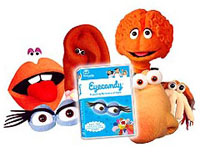 Braincandy is a young company specializing in making DVD and audio CD products for very young children. Currently they have two DVD products available that help children learn about themselves through their flagship title that focuses on the five senses; a second is all about sight.
 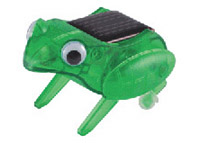 OWI is a technology toy company that specializes in offering small robotic science kits. This year they unveiled a number of new solar powered critters. To assemble, simply snap together all of the electronic parts. No soldering is required. Then you can watch them move when a light source is made available to power their motors. While you cannot currently purchase these items through the OWI website, I’ve provided links here to another distributor where you can purchase the four robots demonstrated at the show; a
  Leveractive has succeeded in creating two very engaging and very playful CD-ROM titles specifically for babies (and their parents). Two different titles, one called Shapes, the other My Animal Friends, allow babies to hit any key on a computer keyboard to bring up many fun animations, music and sound effects. The developers have made sure that there’s no way a baby can accidentally hit key combinations or the Escape key to cause havoc at the desktop level. Each title contains 14 charming activities. The content is very age appropriate and also offers English and Spanish set-up options right on the same CD.
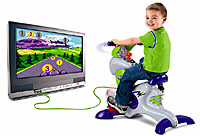 There was much buzz at Toy Fair with the announcement of this toy and rightly so. The Smart Cycle is a TV-based plug-and-play, cartridge-based platform that looks a like a cross between an exercycle for preschoolers and a
 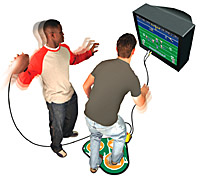 Here are two new plug-and-play products to come out of Radica, a cool tech toy company now owned by
 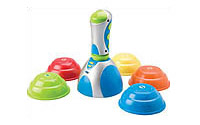 Hyper Dash is a technology toy that could be used indoors or out and does not require a television or computer to use. To start the game, 5 colored electronic targets are placed around the house or yard. Then, holding a talking electronic “tagger”, spoken instructions are given to the child, like find the blue target, then the red, etc. There are different game settings that focus on math skills, team work, and timed-based searches. As a child successfully finds the requested target, the music, pace, and complexity of each new request increases. This toy is recommended for children ages 5 – 8.
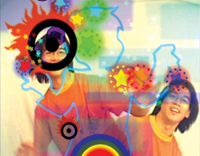 The company TikTokTech was showing two different stand alone TV plug-and-play devices. A small camera unit is placed on top of your television to play either music games or a combination of music and art games, depending on which device you purchase. While motion-based products have really only been around for a short while, these are the only titles available that provide a freeform artistic or musical experience for kids. For those that follow motion-based games, I strongly recommend checking out the
 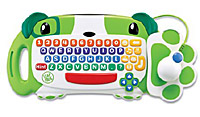 The ClickStart plug-and-play toy provides young children the experience computing in a fun and safe way, without tieing-up mom or dad’s home computer. This product includes a child-friendly keyboard and mouse, which can be set up to accommodate left or right handed users. The on-screen learning is guided by a friendly puppy named Scout. Children collect food treats for Scout as they complete games using numbers, letters, shapes and colors. This toy is a cartridge-based platform which means you can expect to see a number of different titles available to use with the base unit later this year. ClickStart is intended for children ages 3 – 6.
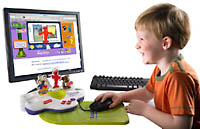 The Easy Link Internet Launchpad acts like a mom-approved dashboard to preschool-safe content on the web. Say a child would like to visit their favorite Sesame Street online game. All a child needs to do is pick up one of the many miniature figurines, in this case Elmo ( or Barney, Clifford, the Wiggles, Thomas the Train, Bob the Builder, and others) and place the figurine in its designated spot… a little like placing the round peg in the correct hole. Once inserted, the device automatically will link its user to the games section of sesamestreet.com. No typing is necessary and all content locations are child-safe with no external links to undesirable content. This product works best with children ages 3 – 6.
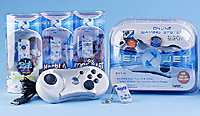 NetJet is a clever USB connected handheld device created by Tiger Electronics, a division of Hasbro. NetJet consists of a handheld game controller and a game key. Each game key inserted into the controller allows its user to access different casual game content online. Popular games using familiar characters and brands are available through this device, but not to those without the controller and keys. The NetJet environment is also free of advertising. No banner of pop-up ads here. Kids are also kicked offline once the NetJet device is removed from the USB port. By this coming fall season, 40 different casual game titles will be available for purchase. This product will appeal to casual gamers, both young and old, but Tiger is best know for their success with the tween market. This is not a learning product, but NetJet is an excellent use of plug-and-play technology.
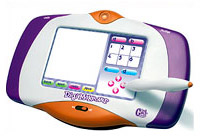 This TV plug-and-play device first appeared at last year’s Toy Fair. It has a built in camera which allows it’s user to take a picture of oneself, then, through the controls on the tablet, modify hairstyles, add jewelry, and apply makeup. (Note: This product has brought about much discussion in our office about female stereo-typing and the kinds of messages it sends out to young girls. In our own testing of the product, we find that kids enjoyed the product greatly when we referred to it as a “stuffed animal makeover” toy. Kids couldn’t stop laughing when they gave a giant stuffed Pikachu and other fuzzy friends a new hairdo and pearls!) What’s new here is Radica has hinted it will be releasing an newer version of the device later this year but no formal announcement has been made.