Archive for the 'Video Links' Category

Thursday, August 23rd, 2007
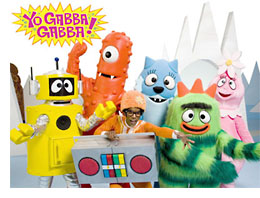
Yo Gabba Gabba photoThe long awaited debut of Yo Gabba Gabba on Nick Jr., the new preschool television show with a wonderfully fresh approach to learning, has finally arrived! An early pilot for the show first appeared online in mid-2006, making a viral splash, and caught the attention of a number of executives in the broadcast world. Nick Jr. made it official at the start of 2007 with an announcement that the show would start airing late this summer. A number of preview clips have been available on YouTube and OnDemand cable services. As of this week the show can be seen about mid-morning each weekday throughout the country!

Yo Gabba Gabba is like a Saturday Night Live variety show for preschoolers. Each episode is punctuated with interesting musical guest stars, clever animation “mini-shows” and fun and quirky shorts of retro video games and dancing kid clips. Dance and movement are the underlying theme to almost every aspect of the show. Many performers slated to appear on the show include: Mark Mothersbaugh of Devo fame and critically acclaimed music aeficianado of film and television, The Aquabats, The Aggrolites, Biz Markie, The Shins, Sugarland, The Salteens, Smoosh, Mya, Sean Kingston, Nikki Flores, Rahzel, Cornelius and Shiny Toy Guns. The show also promises other surprise appearances from guests like Tony Hawk, actor Hector Jimenez, Elijah Wood, Laila Ali, and others.
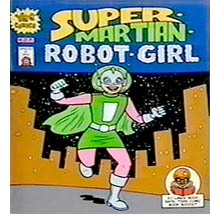
Super Martian Robot Girl photoThe first season of Yo Gabba Gabba will include 20 episodes. Much like any new show, it takes some time to hit your stride and find that natural beat. The first few shows are good; some parts are stronger than others in their appeal, but an improvement in show quality can be seen from episode to episode. The second show, themed “Summer”, is very entertaining. The performance by the band The Aquabats with their song “Pool Party” has made me an instant fan of the group. A segment called “Cool Tricks” where kids (and sometimes adults) show off a unique skill they have learned, and a re-occuring animation segment called “Super Martian Robot Girl” are also very entertaining. I thought this show was good, and then I saw the fourth episode called “Dance”. It was just plain rockin’ with great rap music, a “red-light, green-light” approach to dancing for youngsters, and striking video effects that made me feel like going out to a the dance club! I’ve seen a wonderful progression in the quality of music over this short span of shows and am eagerly awaiting more of the same with shows yet to air.
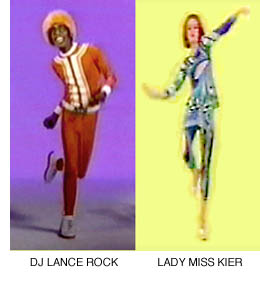
DJ Lance Rock and Lady Miss Kiev photoWhether intentional or not, you can see many other influences on the show. The main sets and some of the characters found in Yo Gabba Gabba have a Kure Kure Takora flavor, a popular Japanese program that aired in the early 70’s. While the Kure Kure Takora show was originally aired as a children’s show, it’s storylines and themes might not have been the best content for younger audiences. It does, however, have a significant adult following. The characters themselves share a creative quality from artists like Tim Biskup and Paul Frank. The main human character, DJ Lance Rock, appears to share a similar fashion sense from Lady Miss Kier of the band Deee Lite. (Maybe an excellent future guest for the show!)

So, as a Gen-X’er, I’m hooked. I’ve been waiting for this show ever since Pee-Wee’s Playhouse stopped producing new shows. But will young children like it? You bet! Strong rhythmic music and encouraging movement is an excellent way to grab the youngest of viewers. The visuals are fun and appealing. There are many parts of the show young children can relate to directly and others that will create an aspirational desire to try something new. It encourages children to feel good about moving and not to worry about “doing it the wrong way.” Make sure your living room floor is clear, because these future young hipsters will get up off the couch and start moving and grooving soon after the show begins. You just might find yourself dancing around to the show as well.

In my mind, children’s television shows can be grouped into two camps. There are shows that children and adults can watch, love, and learn from together. Then there are shows that children will watch and adults can’t stand. Yo Gabba Gabba is one for young and old alike with plenty to please both groups. The show is very entertaining in a fresh whimsical style wrapped in cool pop culture, animation, music and dance. Get ready to hear lots more from this clever, unique, and inspiring show!

BONUS INFO:
Check out these other sites about the show:
Yo Bloga Bloga
Archive of the early Yo Gabba Gabba website
Yo Gabba Gabba LiveJournal
Photos of World Premiere of Yo Gabba Gabba, July 8, 2006
Average Rating: 4.5 out of 5 based on 254 user reviews.

Friday, August 10th, 2007

On August 7, 2007, Georgia Tech professor and video game designer, researcher, and critic, Dr. Ian Bogost appeared on The Colbert Report to discuss how video games can be used to influence and change social and political thinking. Bogost has a new book out called Persuasive Games: The Expressive Power of Video Games published by MIT Press. You can also visit Bogost’s popular website called Water Cooler Games where he discusses, reviews, and analyzes video games that have an agenda. Click this video link to see Bogost on The Colbert Report.

Average Rating: 4.8 out of 5 based on 268 user reviews.

Tuesday, August 7th, 2007

Earlier in the year, I posted an article about a neat electronic toy called the Eyeclops that’s bound to be a big seller later this year. This $50 dollar handheld plug-and-play device was created by toy company Jakks Pacific and will start appearing in stores any day now. Once plugged in, this toy turns your television set into a powerful 200x microscope. Warren Buckleitner, editor of Children’s Technology Review magazine, recently posted a video of this toy product in action (the video is included below.) While this toy is not specifically positioned as a learning product I can see it finding its way into many a classroom. Watch this toy turn your child into a junior scientist with simple everyday objects found in the home. Recommended for children (and interested adults) ages 6 and older.

Also, take a look at this video of the EyeClops in action. Item’s being explored close up include:
Table salt, kosher salt, sugar, organic sugar, soap bubbles, lint from a clothes dryer, blue jeans, fish food, mosquito, head lice egg shell, man’s facial hair, sand paper, US Penny, and a feather

Average Rating: 5 out of 5 based on 233 user reviews.

Monday, June 25th, 2007

June has been a busy month with conferences and events. There are many newsworthy items to report. Among them is my recent visit to the One Laptop Per Child (OLPC) Game Jam event held recently outside of Boston. This gathering of developers, programmers, and a few artists and teachers, was for the benefit of creating learning games to be used on the latest XO laptop (what the OLPC device is often called.) While I could only attend the opening night of this weekend long event, I finally had my chance to test out this new machine. Many details about the XO can be learned from the OLPC website and from an independent OLPC news source called OLPC News. Here are my first impressions of the B3 (Beta 3 XO laptop) device:

  • The laptop is much lighter in weight and smaller in size than I expected. Opening up the folded laptop was initially hard to do. The little green network “ears” on the machine need to be rotated out of their holding position in order to unlock and open up the laptop. Once you have the monitor up and the laptop open, you also notice that the monitor pivots on the vertical axis so that the monitor can be flipped around and folded back into the computer, just like a tablet PC laptop.

  • As I had heard from many others and saw for myself, the monitor is really impressive. It’s screen is very crisp and easy to read.

  • Next, a closer look at the keyboard: Yes, the QWERTY keyboard was a little small, but ergonomically a great fit for young hands. These smart laptop designers have done what no other computer manufacturer has been able to do to date. They have removed the caps lock key. (Finally!) There are also a number of navigation buttons in the top row of keys. These keys allow the user to quickly move around the operating system.

  • I wanted to see if it was true that an SD slot could be found on the device. (You know, one of those slots where you insert a tiny card into a digital camera, for example, in order to save your digital photos.) Well, indeed, a slot can be found just under the bottom right of the monitor. This SD slot can be used for creating backups of important files, but I’ve also learned that someday a version of Windows could be used through this slot. In an interview with an Argentina news group posted on YouTube , Nicholas Negroponte states this slot was included mostly for the benefit of Microsoft (look at section 4:20 – 4:47).

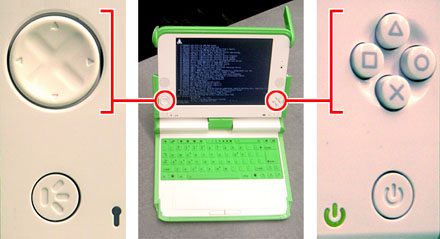
  • What surprised me the most about the user interface was the gaming controls at the bottom left and right of the monitor, just below the built-in speakers. Yes! Gaming controls! (Why hadn’t I seen them earlier in the press photos?): A “D-pad” on the left side of the monitor and shape buttons (triangle, circle, square and “X”) just like those found on a Sony Playstation controller on the right. (See image below.) The development language for the laptop is an open source subset of Python called Pygame. The way in which one accesse these game controls were not specifically called out during the Game Jam event, but for an overview of how to develop games in Pygame for OLPC, see this video.)

Overall, the laptop left me very impressed. There are a number of small rough edges to smooth out, but it’s amazing to see just how far this OLPC machine has come.

OLPC XO laptop game buttons

Average Rating: 5 out of 5 based on 253 user reviews.

Tuesday, May 29th, 2007

Dr. Ellen Wartella, executive Vice Chancelor and Provost of the University of California at Riverside, and youth media expert, spoke in Boston recently at a conference put on by the Society for Research in Child Development (SRCD). Ellen has been involved with many important studies regarding kids, young and old, and their media habits. During her presentation, Ellen discussed the ever expanding nature of media use by youth audiences citing three different studies that collectively span almost 100 years.

The first study presented was conducted in 1911 in New York City. 1, 140 youths age 11 – 14 participated in the study and were found to be spending 4 to 5 hours a week watching movies at the nickelodeon. It’s worth pointing out that movies were the primary media format consumed at the time by younger audiences; Radio and television were not available yet, and magazines specifically targeting this demographic had not yet been discovered as they would be in later decades.

Next, Ellen referenced a study conducted in the 1930’s outside of New York City in Westchester County. 795 high school youths were asked to keep a diary of their media habits. The results of this study showed that this audience had an average of 7 hours of leisure time during the week on weekdays and 11 hours of leisure time averaged over the weekend. This group listened to the radio on average for almost 5 hours a week (4 hours and 40 minutes) and watched about 5 hours of movies per week. Collectively this group consumed about 10 hours of media a week, out of a total of 18 hours of leisure time within that week.

The latest study discussed was that of the Kaiser Family Foundation on Media in the Lives of 8-18 Year olds, published in 2005. More than 2, 000 children were asked to keep diaries of their media habits. The results of this study found that this age group spends about 6.5 hours a day consuming media, primarily screened media, and of that, about 26% of this time is often spent using multiple media types at the same time. (Also surprising in this and related research at Kaiser which I discuss in a prior post that children ages 0 – 2 were found to be watching about 2 hours of screened media a day.) In another post I reference a 2007 NPD Group study that found kids ages 5 – 12 have about 6 hours of leisure time per day with about 14 hours per day over the weekend. While these two different studies were not conducted using the exact same age group, the research suggest about 45 hours of media consumption a week out of about 60 hours of leisure time a week.

If you would like to hear an audio recording of this entire presentation where Dr. Wartella touches on other aspects of media use, like the type of content viewed and food advertising to kids through media, click here.

Average Rating: 4.6 out of 5 based on 282 user reviews.