Archive for the 'Child Age/Grade/Term' Category

Sunday, June 15th, 2008

Erik Strommen of Playful Efforts photo This past week I was at Northwestern University to participate in a conference called Interaction Design and Children (IDC). It’s a fantastic event where researchers, developmental psychologists and technology inventors and experts gather together to share information, research, and advice about creating effective interactive experience for children through technology.

There were many interesting presentations and posters offered which I hope to touch on in the coming days. One presentation in particular I enjoyed was delivered by Erik Strommen, founder and developmental psychologist of Playful Efforts. Erik and I were on a panel together along with Kathleen Alfano, the Director of Research for Fisher-Price. The panel was moderated by Edith Ackermann, who is currently a visiting scientist at MIT’s Center for Advanced Visual Studies. Among Edith’s amazing credentials is that she also worked with and studied under Jean Piaget. All of us discussed the importance of research in the creation of successful interactive technology products for children.

After opening remarks from Edith, Erik began his presentation by stating he would not be showing any Powerpoint slides because he is a member of the “Informal Society for the Suppression of Powerpoint” (Erik worked at Microsoft for many years.)

Next, Erik discussed the difficulty of testing interfaces for software and technology toy products that don’t exist. In many cases, researchers will be brought into a product development team to explore the effectiveness of an interface that has yet to be built. In such cases when you’re called in, it’s your duty to determine how best to guide the development of these new interfaces.

An important quote Erik mentioned that’s worth repeating:

“New interfaces raise a blizzard of never before asked questions that challenge conventional wisdom. Only after collecting data and seeing how such interfaces work with children can you determine how effective these new interfaces will be with children.”

Here are a number of tips Erik mentioned to guide successful child/interaction research:

  • Seek out “parallel literature” to inform your design.
    You may not find exact research you’re looking for regarding the new interface you wish to build, but you can learn a lot about how to inform your design by reading similar interface studies. For example, Erik recommends checking out “studies on social interaction and discourse patterns” to inform social interface design.

  • When prototypes don’t exist, fake it.
    Erik referred to this as “Wizard of Oz” testing. This is when the “man behind the curtain” may be carrying out audio or other functionality needs as part of a down and dirty prototype to test with. Always remember you may not be able to recreate the entire experience this way, just the crucial testing parts. How you define the testing will effect your mock-up. Focus ONLY on the developmental issue that need to be answered. DON’T focus on the technology! Be concerned with timing and vocabulary in your prototype scripts.

  • Understand the schedule and development process of your client.
    How much time do you have and where in the development process do you have the opportunity to make changes in the design? Definition of the interaction with your user needs to be defined up front. It is a deliverable that affects the entire development process, so work fast and deliver your findings early before crucial product development efforts begin.

  • Keep everyone informed.
    Let everyone on the development team know when findings will be presented. Keeping team members informed as to the time when conclusions will be shared better allows for changes that can be incorporated into the development schedule.

  • Be specific with your research question.
    Don’t ask overly broad or numerous questions that will keep you from ever finding the mission critical answers you need to inform you product development team. Remember, generally speaking, companies don’t want to pay for research and they don’t want to schedule research. But be ready, once the information is available, everybody will beat a path to your door for the results! Also be aware that the broader your research question, the more complicated your prototypes will become.

  • Make friends with the engineers on your team.
    They will be your best allies for creating prototypes. Engineers also care about having answers as to how best to develop for a specific audience

  • Don’t let the perfect be the enemy of the good.
    Early prototypes can be very different from the final product. You may not have the right characters or correct voices in your prototype but if you ask the right question, the results of your test will be invaluable. Remember, it’s the interaction that you are interested in testing. If visuals or character voices aren’t correct it will not threaten the validity of your testing.

  • Document what you did and the conclusions of your research.
    People will challenge your results and you may not remember everything you need in order to support your conclusions. You may also need to refer to your notes in the future when conducting similar studies.

At the end of the Erik’s presentation, he showed a number of prototypes used in technology toy testing.

To see video of Erik Strommen’s presentation at the IDC event, click below:

Average Rating: 4.4 out of 5 based on 206 user reviews.

Friday, June 6th, 2008

[The following is an article I wrote for the May 2008 issue of Children’s Technology Review. For those unfamiliar with this monthly magazine, it’s a great information resource to all the latest software, gaming, and technology products being released for children.]

Last month, I was presenting at a conference for education publishers when someone raised his hand and asked “What’s a Webkinz?” Hmmmm, I thought. Doesn’t everyone know about Webkinz World? Shouldn’t everyone know about this site and others like it without the excuse “I don’t have kids.” The next day, somebody asked me, “What’s an avatar?” I was starting to understand that there were still plenty of publishers firmly stuck in yesterday’s Web 1.0 world. But don’t worry. We’ll fix the problem the way we developers always do – with a Patch.

The Web 2.0.1 Patch is designed to help you become more thoughtful when creating interactive experiences for children (and it works well for school or library websites, as well). Installing this Patch in your brain is a quick and painless process as long as you have a USB 2.01 port just behind your left ear. Or, you can follow these three steps.

STEP 1 – Create an account for yourself in a virtual world like Club Penguin, Pirate’s Online, Nicktropolis, Second Life or any of the many virtual worlds that are popping up all over.
Once you have an account, test it out and play with it. Keep in mind – like many other Web 2.0 products available you may not see the benefits immediately, but you will see incremental improvements every time you come back to visit one of these virtual worlds.

STEP 2 – Upload digital photos to Flickr or a video to YouTube.
Don’t forget to include some tags that describe what you’re uploading so for others can easily find it. Once you have posted something, control your excitement, pat yourself on the back, and email friends and family with a link to your newly posted UGC (User Generated Content)!

STEP 3 – Create a personal profile on Facebook, LinkedIn, or any another similar social networking site.
If you don’t know one that’s right for you, ask a smart computer friend what she uses (chances are she will have already installed the 2.0.1 Patch and will be familiar with the requirements). If your techy friend is not available, casually ask someone under the age of 20 what sites they use. Don’t tell them that you are setting up a new account. If you do, he or she might give you that “Web 1.0 look” and then slowly back away.

Here are just a few of the benefits you’ll be able to enjoy from downloading and installing this Patch:

  • You will start from, and work from, a central plan.
    If you’re designing a site or service with social features, there will be no more “winging it” or making it up as you go along. Thinking through the design of your new web idea, writing it down, and sharing it with all of your team members are more important now than ever before.

  • You’ll test your work with your target audience.
    The Patch works best when testing is considered at the very beginning of your product’s definition on paper and throughout the development process. Some of you might explain “We never had to test our products during the Web 1.0 days!” Yes, in many ways the Web 1.0 days were a simpler time, and a time we will all look back on with nostalgia. However, the hustle and bustle of today’s fast-paced Web 2.0 world demands ongoing testing.

  • After you install the 2.0.1 Patch, you’ll have zero tolerance for UI (user interface) mistakes.
    If buttons or other interactive controls don’t function as they are supposed to, your product will be in violation of the User’s Agreement. It is important to think through the entire user experience fully before launching an interactive product. This requirement can’t be overstated. You can’t blame it on Flash, Microsoft or some browser error. That’s the 1.0 baby talk of the past.

  • If you are a Web 2.0 savvy developer, keep in mind that it is possible your audience is not acknowledging that he or she is a Web 1.0 user.
    Education outreach and friendly intervention is an important component of the Web 2.0 vision. Take the time to gently explain how their actions are hurting others around them. Also explain the benefits of the Web 2.0 universe. (Note: This should be apparent in the development documentation you will have recently created for your plan). To keep your Web 2.0 chops fresh, try out the latest ground breaking technologies, like the iPod Touch interface, for example. You may not know how to find it at first, but be diligent.

These steps can avoid wasting countless hours and dollars, and they can prevent you from having to install the 2.1.1 Patch and a 2.1 Update. In the end, keeping your Patches up-to-date can result in better products and happier users.

Average Rating: 4.4 out of 5 based on 227 user reviews.

Wednesday, May 14th, 2008

On May 9th, the first ever Joan Ganz Cooney Center Symposium was kicked off at the McGraw-Hill offices located in New York City. The Joan Ganz Cooney Center is the newest addition to the Sesame Workshop enterprise. Its mission is to offer guidance, research and insight into how children can learn through emerging media. The symposium itself was an amazing event. A stellar list of speakers and influential attendees from diverse areas of education, broadcast, gaming and the toy world came together to discuss the future of learning and technology for children in the 21st century. This jam-packed event included presentations from over 34 different industry insiders. Over 150 invited guests filled the room. Included on the guest list was Congressman George Miller (D-CA) who is the chairman of the House Education and Labor Committee.

All of the presentations offered many important perspectives and voices that are shaping the learning and technology conversation today. A number of speakers served up new research and valuable insights to chew on long after the event concluded. While there was significant take-away from all of the speakers, I would like to call out two specific presentations. These include the presentations of Connie Yowell of the MacArthur Foundation and Jennifer Kotler of Sesame Workshop.

First and foremost, Connie Yowell‘s presentation on new learning paradigms was simply amazing, passionately delivered, and has given many folks the most food for thought about the future of new media and learning. Connie expressed the importance of seeking out the right questions to ask at the beginning of our journey, stating that in order for us to realize the opportunity in front of us, we must be ready for a significant paradigm shift in the existing learning conversation. I heard many attendees echo the importance of Connie’s words at the conclusion of the event. In the matrix below, I have included an audio recording of Connie’s presentation. A transcription of her comments can also be found in my next blog article.

During this part of the symposium, both Ellen Wartella (of UC Riverside) and Connie Yowell’s words were offered in succession and both speakers expressed a great need for more research and a significant rethinking of our current approach to education and learning. Their comments were vital ones to be heard by policy makers, and while Representative George Miller attended the event for most of the day, sadly he left just before Ellen and Connie took the stage.

The next presentation I’d like to call attention to was that delivered by Jennifer Kotler. Jennifer presented two reports, but one in particular has an important story to be told. This report gathered information from interviews conducted with children ages 6 to 9. It asked them about their favorite games and websites. Included within this report was a very clever validity check that, when its findings were presented, calls into question any other self-reported findings from other organizations asking similar questions about kids and online preferences.

In the study, kids were asked about their technology preferences. Included within the interview question sets were six non-existent website and game names. That’s right, online products that were completely fictitious and do not exist. What this report revealed was that 56% of those surveyed claimed to have played these non-existent games and websites. How could this be?

What the research suggests is that kids may be more likely to exaggerate their actual use of technology because of the apparent “cool factor” and/or the aspirational aspect of these technologies. How does this cool/aspirational factor play out within the data? Here are just a couple of examples: When kids were asked if they have ever visited a MySpace page, the “clean” data suggests that only 19% of those surveyed have visited the popular online destination whereas the non-valid data states the number is 54%. When asked about posting video on YouTube, the numbers are 7% (valid data) vs 42% (non-valid data).

These findings suggest that similar studies conducted by other organizations would benefit greatly by the inclusion of a validity test in their research. If not, the numbers reported could be significantly skewed from what they should be. Now that we’re all armed with this information, go back and look at all the claims regarding other popular children’s destinations, like Club Penguin, Webkinz, and the like. Hmmmmm.

I would also like to call out presentations made by Bernie Trilling of Oracle Education Foundation about 21st Century Learning Skills, Allison Druin for her work with the International Children’s Digital Library project, Krista Marks of Kerpoof, James Paul Gee and his report on Getting Over the Slump, and Jim Styer of Common Sense Media for his report on how parents and educators view the educational potential of new media.

The matrix below offers audio recordings, papers, and related websites collected from the event. Friends and colleagues who know me well will tell you that I’m rarely without a camera or recording device at such events. I believe it’s important to capture and share such information with everyone so that industries can move forward together. The list below includes audio recordings from most of the speakers. However, my apologies go out to the last 8 or so speakers, mostly from Warren Buckleitner’s Dust or Magic panel, for by the end of the day my recording device lost power.

All of the audio clips can be downloaded as a single zipped file here.


Audio PDF Site Speaker or Description
Yes – – Opening video (audio recording only)
Yes – – William Oldsey – EVP, McGraw-Hill Education
Yes – – Gary E. Knell – President and CEO, Sesame Workshop
Yes – – Joan Ganz Cooney – Co-Founder, Sesame Workshop
Yes Yes – Michael Levine – Executive Director, Joan Ganz Cooney Center
Yes Yes – Jim Steyer – Founder & CEO, Common Sense Media
Yes Yes – James Paul Gee – Mary Lou Fulton Presidential Professor of Literacy Studies, Arizona State University
Yes – – Questions and Answers
Yes – – Claudia Wallis – TIME Magazine
Yes – – Buwon Tran – Director of Consumer Research, Casual Entertainment, Electronic Arts
Yes – – Jennifer Kotler – Assistant VP of Domestic Research, Education, Research and Outreach Department, Sesame Workshop
Yes – – Susan Neuman – Professor of Educational Studies, University of Michigan
Yes – – Francie Alexander – SVP of Scholastic Education and Chief Academic Officer, Scholastic
Yes – – Questions and Answers
Yes – – Lisa Guernsey – journalist, author of Into the Minds of Babes
Yes – – Marilyn Jager Adams – Research Professor of Cognitive and Linguistic Sciences, Brown University
Yes Yes – Bernie Trilling – Global Director, Oracle Education Foundation
Yes – – Nichole Pinkard – Senior Research Associate & Assistant Professor, University of Chicago
Yes – – Margaret Honey – SVP, Strategic Initiatives & Research, Wireless Generation
Yes – – Lesli Rotenberg – SVP, PBS KIDS Next Generation Media Initiative
Yes – – Jayne James – Executive Director, Ready to Learn, Corporation for Public Broadcasting
Yes – – Questions and Answers
Yes – – U.S. Rep. George Miller (D-CA) – Chairman of the House Education and Labor Committee
Yes – – Gabriel Zalzman – SVP and General Manager, Fisher-Price
Yes – – Bing Gordon – Chief Creative Officer, Electronic Arts
Yes – – Linda Roberts – Former Director, Office of Educational Technology, US Department of Education
Yes – – Rob Lippincott – SVP, Education, PBS
Yes – – Ellen Wartella – Executive Vice Chancellor & Provost, UC Riverside
Yes – – Connie Yowell – Director of Education, MacArthur Foundation
– – – Delia Pompa – VP for Education, National Council of La Raza
– Yes – Warren Buckleitner – Editor, Children’s Technology Review
– – Yes Allison Druin – Director, Human-Computer Interaction Lab, University of Maryland
– – – Michael T. Jones – Chief Technology Advocate, Google, Inc.
– – Yes Krista Marks – CEO & Co-Founder, Kerpoof
– – Yes David Rose – Chief Scientist, CAST
– – – Kathy Shirley – Technology and Media Services Director, Escondido Union School District
– – – Michael Levine – Executive Director, Joan Ganz Cooney Center

Average Rating: 4.5 out of 5 based on 259 user reviews.

Thursday, April 24th, 2008

Theo Jansen - Animaris Rhinoceros photo The artwork developed by kinetic sculptor Theo Jansen is truly inspirational. The vision behind his movable works is that someday these mechanical beasts could live on any beach in the world as if they were some sort of futuristic animal that survives on wind power. In a way, Jansen has developed an improved version of the wheel, one that can easily travel over sand. One noteworthy creature he developed is called Animaris Rhinoceros, and it looks a cross between a Star Wars AT Walker and a dinosaur. It stands over five meters (16 feet) tall and weighs 3.2 tons!
So imagine my surprise when I saw a fully functioning remote control robot that looks very close to this Theo Jansen piece. It’s eight legs and walks in a similar manner. It also has an extendable arm for grabbing items. The miniaturized version was created with various parts from many robot kits offered by Innovation First. This amazing electronics company makes hobby kits for educational use and also developed the fully functioning Theo Jansen-like robot you can see in the video below.

I was told by representatives at Innovation First that this specific robot has garnered so much interest, that they’re thinking about making a specialized kit so others can also build this specific work. Bringing robotics, engineering AND inspirational sculpture into the classroom, now there’s a forward thinking idea worth watching!

Average Rating: 4.4 out of 5 based on 205 user reviews.

Tuesday, April 22nd, 2008

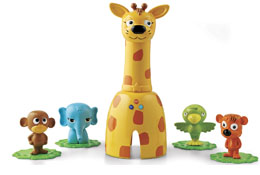
Wild Planet - Animal Scramble RFID toyLast year I wrote about a tech toy product called Hyper Dash developed by the toy company Wild Planet. Hyper Dash is an electronic game that allows one user to hide up to five hockey puck sized targets, indoors or out, and another person can search for these targets with the help of a talking controller. I thought this was a brilliant use of RFID, a technology that relies on small paper thin microchips that can be detected within short distances via the radio frequencies they emit. (So when will this technology become standard in all car keys? Imagine the time we could all save each morning trying to find them!)

This coming fall Wild Planet will release a new iteration of this technology enhanced play pattern specifically for preschoolers. The product will be called Animal Scramble and it relies uses the same technology, but will support a hide-and-seek learning play pattern using plastic animal characters. The talking controller is a giraffe and the small targets include a monkey, a parrot, an elephant and a tiger. The giraffe calls out different challenges for one or many different players to accomplish, like tag the animal that has stripes, or find the animal that begins with the letter “M”. The animals can be spread out across a living room, backyard, or even a larger space for more exercise.

While Animal Scramble and Hyper Dash are great uses of RFID technology, it feels like RFID is inching along when it comes to being used in new and original ways. I keep waiting to see breakthrough applications that rely on the technology but am surprised at how few new products take advantage of its possibilities.

The only other child-focused RFID product I’ve seen so far this year includes a child alarm system developed by Smart Target called Kiddo. This product sounds an alarm when a child or even a pet you’re watching (or maybe not watching) equipped with an RFID tag moves outside of a designated play area.

Immediately I see how this technology can be used in all the clothes I drop off at the dry cleaner, important books I wish to keep on a designated bookshelf, picking up luggage at the airport, and did I mention the part about car keys?

So today I’d like to congratulate Wild Planet for pushing the RFID envelope. Many more play patterns are yet to be discovered. I look forward to this space heating up. Thank you for leading the charge!

Average Rating: 4.8 out of 5 based on 165 user reviews.